
Does Insight Keep the Heart from Breaking?
Wrestling with Nagarjuna's 7th Chapter


One of the defining characteristics of the human experience is that things, people, and situations seem to come into our lives, stick around a while, then fade away—or end abruptly in a paroxysm of devastation.
Nāgārjuna’s seventh chapter in The Fundamental Wisdom of the Middle Way uses reason and inquiry to show that all this seeming drama is a magic show. When we look carefully, beginnings, middles, and endings become surprisingly difficult to pin down. The drama of things coming into existence and passing out of existence begins to soften, revealing its insubstantial nature.
But what about all the grief and heartache we feel over our endless, inevitable losses—the loss of our health, spouses, friends, children, homes, fortunes, landscapes, accomplishments, cherished worlds? Is Nāgārjuna’s impeccable reasoning supposed to make us feel better?
I don’t know about you, but when a close friend passes away, no philosopher’s insights soothe my grief. In fact, the implication that perhaps Nāgārjuna’s argument should comfort me, if I were just more spiritually mature, more insightful, more awake—that just pisses me off.
I understand the human impulse to try to master impermanence. Is it even possible? If it were possible, would it be something to celebrate?
I’m more inclined to agree with Elizabeth Bishop, whose poem, “One Art” explores our impulse to master loss, concluding with the ultimate futility of this endeavor.
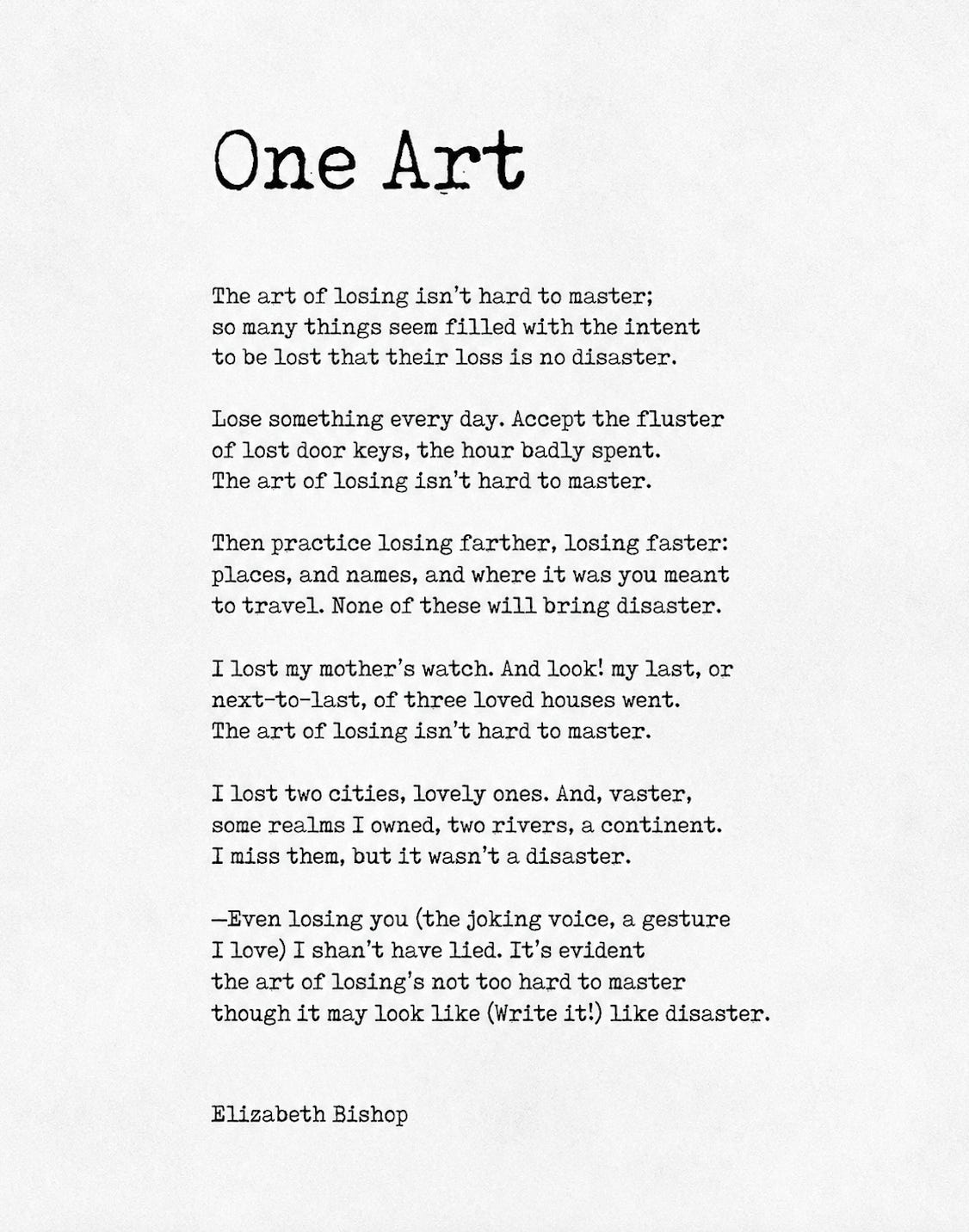
We don’t need to master heartbreak.
Maybe that’s not what Nāgārjuna is suggesting when he leads us through the imaginary nature of all arising, abiding, and ceasing—the conditions of all the things in our lives.
Maybe seeing the magic show for what it is has nothing to do with avoiding grief.
Fortunately, deconstructing the appearance of arising, abiding and ceasing does not leave a barren emptiness. What becomes apparent as we see through these conditions is not a revelation of nothing, but experience as shimmering, free, alive, unlimited.
It has a moving, relational texture. It can’t be known the way the mind knows subjects and objects, but it feels like love.
One of the paradoxes of realizing the insubstantiality of things is that compassion deepens rather than flattens. Love stops being imagined as an isolated possession, an object directed from one subject to another.
It stops being felt as separate from grief.
Nāgārjuna’s deconstruction of arising, abiding and ceasing is not defensive armor against love’s losses and heartbreaks. It offers another gift: a loosening of our assumption that loss and heartache are mistakes, that the appearances we love so deeply should be permanent.
Nāgārjunas insights help shake up our belief that something must be wrong with life if we can’t keep what appears and disappears within it.
As belief in beginnings and endings softens, love reveals itself as the movement of relationship itself. It changes, trembles, contracts, opens as a living texture intertwined with the entire field of experience.
We can see this for ourselves when we examine love’s entanglement with memory, conversation, conflict, touch, silence, expectation, disappointment, attention. Everything participates.
That is a shift in sensibility.
Love, like everything else, is dependently arisen, meaning that it is inseparable from a whole world of inter-connected experiencing. And that is why Nāgārjuna can say, as he does in chapter 7, “Whatever is dependently arisen, such a thing is essentially peaceful.”
Nāgārjuna can’t mean that dependently arisen things are emotionally tranquil. Grief, birth, illness, and love itself all show us otherwise. Nāgārjuna’s peace does not depend on emotional serenity; rather, it is the result of never having to bear the impossible burden of existing alone. Nothing has to defend itself as an isolated essence against the world. Everything already belongs to an immeasurable web of conditions.
Existence is participation. When we see and feel this directly, peace stops depending on permanence; it is the natural consequence of belonging.
This is not something to believe; it’s something to experience. The felt sense of Nāgārjuna’s dependent co-arising is what the guided meditation below explores —not just the negative insight that nothing exists independently, but the intimacy of experiencing how everything exists through everything else.
Emptiness does not give us a world without meaning, intimacy or grief. It gives us a world without isolation.
What does it feel like when nothing stands by itself?
Let’s explore.
(You will find a transcript of the guided meditation below for those who wish to explore at their own pace.")
The Intimacy of Everything in Everything
Find a comfortable position. Allow the body to relax without trying to change anything in experience.
Breath is here, happening by itself.
Sound is here, happening by itself.
The body is here, held by a chair, which is held by the ground, which is held by the earth.
Nothing needs to be improved.
We are simply noticing.
Now turn your attention to the feeling of breathing.
Without altering the breath in any way, try to find the moment when breath begins.
Does it actually have a beginning that can be clearly defined?
Where is the breath? Don’t answer from what you think you know. Can you feel the place of beginning?
Where is it actually located?
Is it in the chest, or in the air?
Is it in the movement of the diaphragm?
Or does breath have its beginning in a wider space?
Does breath begin in the plants and trees that release their oxygen?
Or maybe it begins with the sunlight that nourishes the plants?
Or did it begin in the exploding stars that forged the atoms making oxygen possible?
Where does a single breath actually begin?
Where does it end?
We aren’t looking for an answer. We’re loosening our assumptions about what breath is.
Now turn your attention to sound.
Maybe you hear the wind, or traffic outside, or a bird chirping.
Usually when we hear a sound, we assume it belongs to something in the distance. We imagine that it begins there and travels here.
But let those assumptions soften.
Instead of asking, “What made the sound?” ask “What all is participating in making this sound possible?”
Notice that sound is really only experienced here. “There” is imagined.
Notice that sound is not separate from the air, or hearing, ears, attention, the texture of vibration, the body of a bird, the absence of louder sounds, a receptive nervous system.
Is the sound an isolated event? Or is it a meeting of countless conditions?
Is the sound produced by a single bird? Or is all of experience sounding together?
Now feel the body’s weight against the chair.
Feel the pressure of feet touching the ground.
Feel the support of the chair and the ground.
Is the chair supporting a body? Or is the body supporting a chair?
Without the chair, the body’s posture could not exist.
Without the body, there is no felt experience of a chair.
Are there two sensations here—one of the body and the other of a chair? Or is there a single sensation without a clear boundary? Don’t think about this. Feel it.
When our assumptions about things soften, what do we find when we turn our attention to sensation? Where is it, exactly?
Is there any place in all experience where sensation does not reach? Can you find the place it ends? Don’t think. Feel. Where is the end of sensation?
Now bring to mind someone you love.
Where does this person begin?
In their face? If so, which face is the right one? The one you remember from a recent visit? The one from a favorite picture taken years ago? The one expressing health and contentment? Or the one when where this person was struggling?
Is it their voice that defines them? Which voice?
Their body? But that has changed, too.
Their memories?
Does it matter that so much has been forgotten?
Maybe the person is defined by the influence they’ve had on your life.
Can you find the beginning of that influence? Does it have an end?
Now, rather than picturing the person as an image, explore the texture of the relationship.
Have some of their words and gestures become your own?
Does your body spontaneously respond when you imagine their laughter? Their smell? Their touch?
Which of their opinions have become your own?
Which of your memories do they share?
Where are the actual boundaries between you and this person you love?
Is there a clear place where you stop and your loved one begins?
Or is the relationship a web of movements and shapes, thoughts and feelings without clear boundaries?
And where does this loved one end?
When their heart stops?
When no one remembers them?
When the consequences of their actions stop reverberating?
When their name is forgotten?
We aren’t really looking for an answer here, just noticing that our assumptions about a clearly defined “person” have softened. What actually comes into or goes out of existence?
Now allow your attention to widen.
Feel the room’s temperature.
Feel the texture of clothing against your skin.
Your heart beating.
The rhythm of the breath.
Sounds.
Patches of light and shadow behind closed eyes.
Rather than focusing on separate experiences, keep attention wide—one seamless field without edges.
Does anything here really stand alone?
Can you find a boundary between sound and sensation? Between thought and attention? Between light and vibration?
Or does everything here belong to everything else?
Where is the body without the earth beneath its feet?
Where are thoughts without language and sound?
Where is this life without countless generations?
Where is this moment without light, air, energy, texture, attention?
Notice how the mind looks for a center or view.
No need to get rid of that movement.
But ask, “Does this sense of a center exist by itself?”
Or does this sense of “here” arise from a vast web of experience—
dependent upon the body, vision, memory. movement, relationship?
Can there be a center without this entangled field of experiencing? Can a field without boundaries have an actual center?
Now let these questions fall away.
We don’t need to understand or arrive.
We can rest in the quiet intimacy of this recognition—
Breath depends on air, light, plants, body.
Hearing depends on tone, vibration, space, ears.
Seeing depends on light, shadow, shape, movement.
Life depends on innumerable conditions.
Does anything stand by itself anywhere?
Can we really say what any of this is?
What does it feel like, to know this inter-dependence so intimately?
What part of this inter-dependence is you? What part isn’t?
Can you find a boundary anywhere?
What does it feel like, to be here now without boundaries?
What does this moment feel like before the mind has anything to say about it?